

Inherited a House in Texas? Here’s What to Do When You Don’t Know Where to Start

Introduction: Grief and Paperwork at the Same Time
Losing a parent or close family member is one of the hardest experiences in life. And yet, within days or weeks of that loss, you may find yourself navigating a completely foreign world of estate law, probate filings, mortgage statements, property taxes, and family disagreements — all while grieving.
Inheriting a house in Texas comes with a unique set of responsibilities and decisions that need to be made, many of which have real financial and legal consequences. The good news: you don’t have to figure it all out at once, and you have more options than you might realize.
This guide walks you through the process step by step — from understanding probate, to evaluating the property, to deciding whether to keep, rent, or sell the home — with a focus on giving you clarity, not pressure.
Step 1: Determine How the Property Was Titled
Before you do anything else, find out how the deceased owned the property. This single factor determines how quickly and easily the title can transfer to you (or other heirs). There are four common ownership structures:
- Solely in the deceased’s name: This almost always requires probate — the court-supervised process of transferring assets.
- Joint tenancy with right of survivorship: The property automatically passes to the surviving joint owner without probate. A death certificate and affidavit are typically all that’s needed.
- Community property with right of survivorship: Texas recognizes this for married couples. Same as above — no probate needed.
- In a living trust: If the property was placed in a revocable living trust, it transfers to beneficiaries without probate, often within weeks.
If you’re not sure how the property was titled, you can check the deed at the county appraisal district or county clerk’s office. The deed type will indicate the ownership structure.
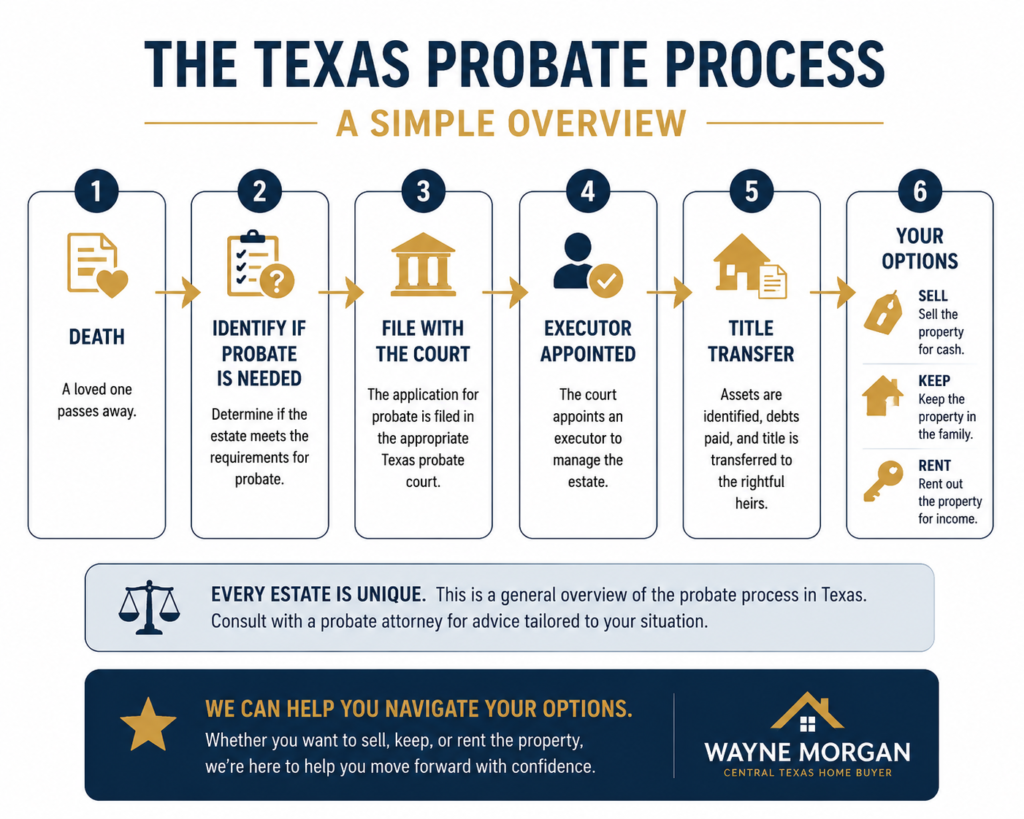
Step 2: Understand Probate in Texas
Probate is the legal process by which a deceased person’s estate is administered. In Texas, the probate process is generally considered more straightforward than in many other states, but it still takes time — typically 3 to 6 months for a simple estate, longer if contested.
Texas offers several probate alternatives worth knowing about:
- Muniment of Title: If there is a valid will and no unpaid debts (other than real estate liens), Texas allows probate ‘muniment of title’ — a simplified process that transfers real property without full estate administration.
- Small Estate Affidavit: If the total estate value is $75,000 or less (not counting the homestead), heirs may be able to use a small estate affidavit to transfer property without formal probate.
- Affidavit of Heirship: If there is no will (intestate succession), heirs can sometimes use an affidavit of heirship — signed by disinterested witnesses and recorded with the county — to establish ownership.
For most inherited homes, you will need to consult with a Texas probate attorney. The cost is generally 2–5% of the estate value, and many attorneys offer free initial consultations.
Step 3: Assess the Property Condition and Costs
Once you have legal clarity, it’s time to take stock of the physical and financial reality of the property. Before making any decisions, find out:
- Is there an existing mortgage? Contact the lender to determine the outstanding balance and whether the loan is current. Most mortgages have a ‘due on sale’ clause that requires full repayment upon transfer.
- Are property taxes current? Delinquent property taxes in Texas accrue interest and penalties rapidly. Check with the county appraisal district.
- What is the home’s condition? Walk through the property carefully. Note any structural issues, roof condition, HVAC age, plumbing, and general deferred maintenance. Be realistic.
- What are the holding costs? Every month the property sits, you’re responsible for mortgage payments (if any), property taxes, insurance, utilities, and maintenance. These can add up to thousands per month.
Step 4: Know Your Three Options
As an heir to a Texas property, you essentially have three paths:
Option A: Keep the Home
If the property has no mortgage (or you can afford to take over payments), is in livable condition, and you have personal or financial reasons to keep it, retaining the home is a valid choice. You’ll need to transfer the title into your name, update insurance, and budget for ongoing ownership costs.
Option B: Rent the Home
Turning the inherited property into a rental can generate ongoing income. This works best when the home is in rentable condition, the local rental market is strong, and you have the bandwidth to be a landlord (or hire property management). Be aware that becoming a landlord has legal and financial responsibilities — and if the home needs significant work before it’s habitable, renovation costs can be substantial.
Option C: Sell the Home
Selling is the most common choice for inherited properties, especially when there is no mortgage, the home needs updates or repairs, the heirs live out of state, or multiple heirs need to divide the proceeds. The method of sale matters:
- Listing with an agent: Good option if the home is in marketable condition and you have time. Expect 45–90 days to close and typical selling costs of 7–9%.
- Selling as-is to a cash buyer: Ideal when the home needs significant repairs, the estate needs to close quickly, or you simply want to avoid the complexity of preparing and marketing a property during a difficult time. Wayne Sells Houses specializes in exactly this.
What If Multiple Heirs Are Involved?
This is one of the most common complications in inherited property situations — and one of the most emotionally charged. When a parent leaves a home to three adult children, for example, all three must agree on what to do with the property.
If one sibling wants to sell, one wants to keep it, and one is indifferent, reaching consensus can take months and strain family relationships. A few strategies that help:
- Have an honest, structured family meeting early — before emotions escalate.
- Get a professional property valuation that everyone can reference.
- Consult the estate attorney about each person’s legal rights and obligations.
- Consider a buyout: the sibling who wants to keep the home pays the others for their shares.
If agreement is truly impossible, Texas law allows any co-owner to file a partition lawsuit that forces the sale of the property. It’s better — and far cheaper — to reach a voluntary agreement before it gets to that point
The Tax Picture: Stepped-Up Basis and Capital Gains
One significant financial benefit of inheriting a home (rather than receiving it as a gift during the owner’s lifetime) is the stepped-up cost basis. This means your cost basis for capital gains purposes is the fair market value of the home at the time of the original owner’s death — not what they paid for it.
For example: if your parent bought the home in 1985 for $80,000 and it’s worth $350,000 when they pass, your cost basis is $350,000. If you sell it shortly after for $360,000, you’d owe capital gains on only $10,000 — not the full $270,000 in appreciation. This is a major tax advantage that makes selling soon after inheriting especially attractive from a tax perspective.
Always consult a CPA familiar with Texas estate tax rules to understand your specific liability.
How Wayne Sells Houses Helps Heirs
Wayne Morgan understands that inherited property situations are sensitive. Heirs are often out of state, working through grief, navigating family dynamics, and dealing with a home that may not have been maintained. He has helped families across Central Texas sell inherited properties quickly, cleanly, and with genuine compassion.
When you work with Wayne Sells Houses on an inherited property, you get:
- A cash offer within 24–48 hours of a property visit
- Purchase in any condition — no cleanout or repairs required
- Flexible closing timeline to accommodate probate or co-heir timelines
- Experience working with estate attorneys and multiple decision-makers
- Zero commission, zero repair obligations, zero surprises
Your First Step: Don't Wait Too Long
The longer an inherited property sits, the more it costs — in taxes, insurance, utilities, maintenance, and carrying costs. And if the home has a mortgage, missed payments can trigger foreclosure proceedings even in an estate context.
You don’t have to have everything figured out before you reach out. Wayne offers a completely free, no-pressure consultation where you can simply ask questions and understand your options. Call (512) 997-8457 or visit waynesellshouses.com to start the conversation today